
How to Create a Mail Merge Campaign
Introduction
Section titled “Introduction”A campaign sends one personalized email to every eligible row of a Google Sheet. This guide covers the whole path in the order you will meet it: choose a Sheet, pick or write a template, preview and test, check the launch summary, start, and read the report.
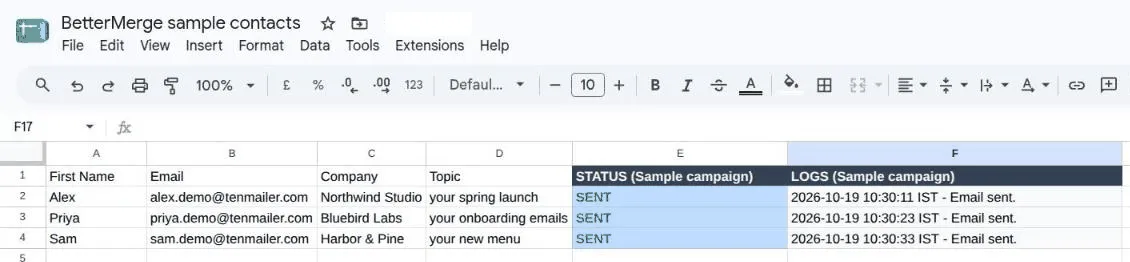
If this is your first campaign, the Beginner tutorial walks through a complete example. Here you will find the detail behind each step. The screenshots use a small sample list, with one Sheet called “BetterMerge sample contacts” and the columns First Name, Email, Company, and Topic.
Before You Begin
Section titled “Before You Begin”- A Google Sheet with your recipients. Row 1 must contain column names, and one column must hold the email addresses. See Set up your contact list.
- A BetterMerge account. The Free plan can send campaigns with open and click tracking. Some options in this guide need a paid plan; each one says so.
Step 1: Start a New Campaign
Section titled “Step 1: Start a New Campaign”Choose the place you prefer to work. The campaign editor is identical in both.
In the web app
Section titled “In the web app”- Sign in at app.bettermerge.com.
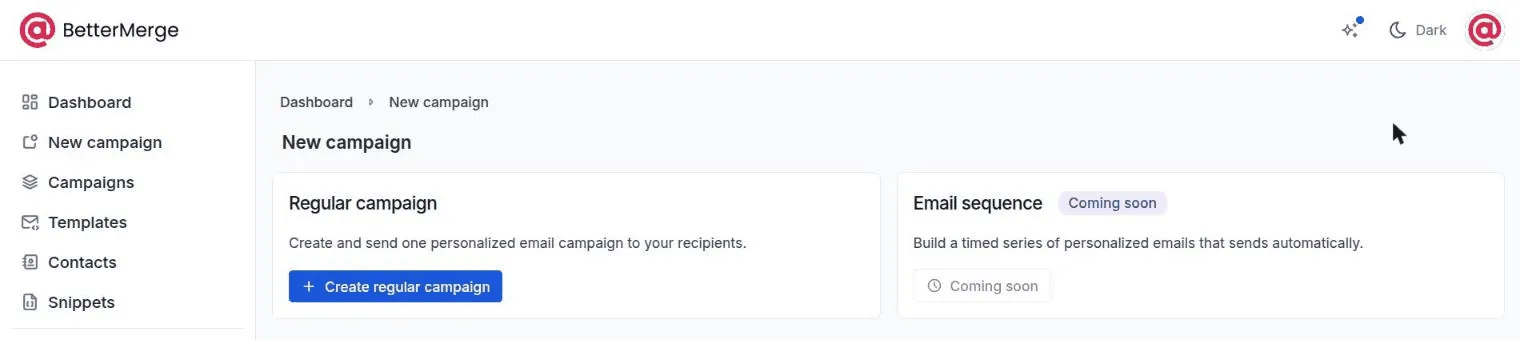
- Click New campaign on the Dashboard or in the left menu.
- Click Create regular campaign.
In the Google Sheets add-on
Section titled “In the Google Sheets add-on”- Open your Google Sheet.
- Click Extensions > BetterMerge Mail Merge for Gmail™ & Google Sheets™ > Open Dashboard.
- Click New campaign, then Create regular campaign.
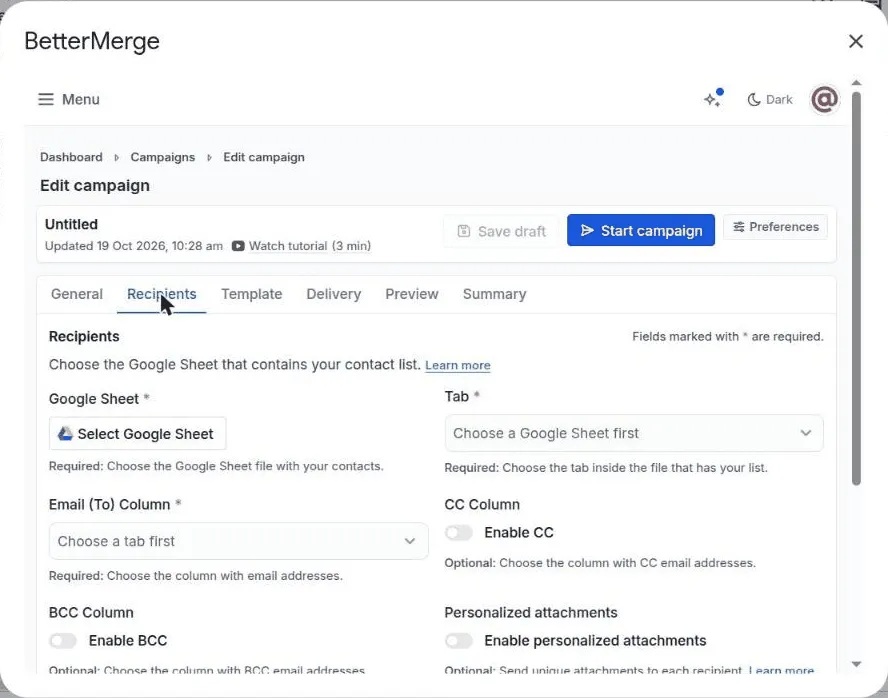
The add-on opens the editor inside a modal over your Sheet. Choose your Sheet on the Recipients tab, just as in the web app. Need to install it first? See Install the add-on.
The Editor at a Glance
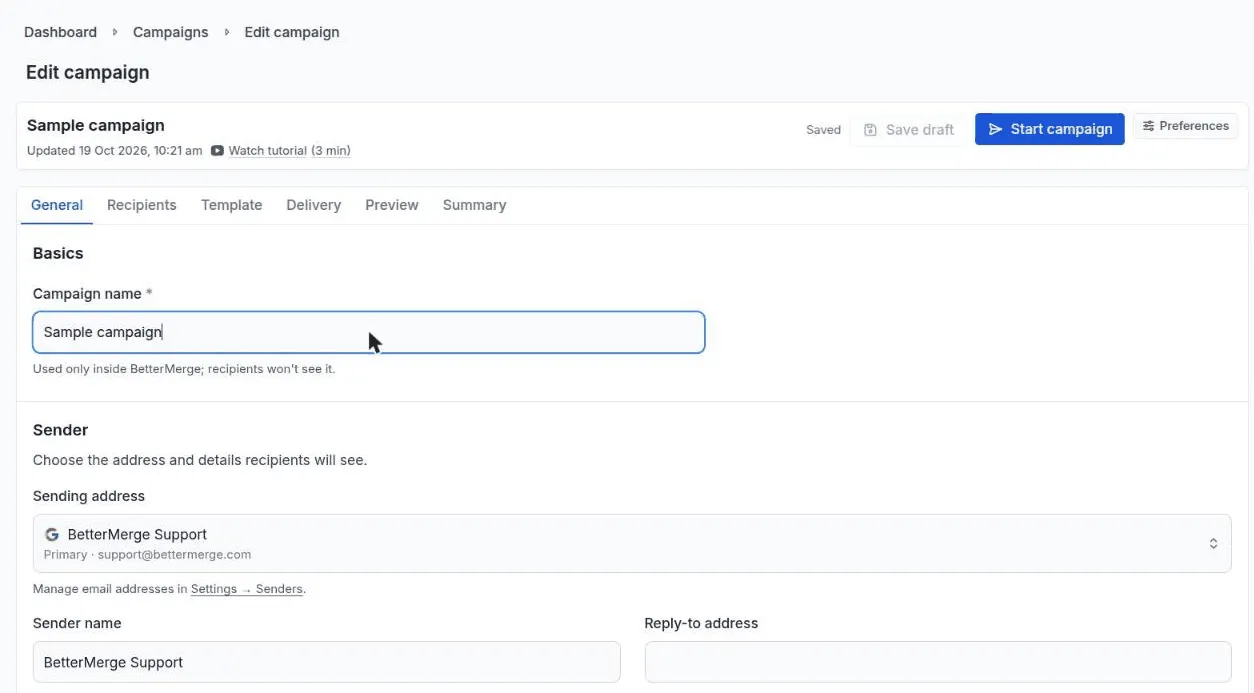
Section titled “The Editor at a Glance”A new campaign is saved as a draft and opens on the General tab. Work through the tabs from left to right.
| Tab | What you do there |
|---|---|
| General | Name the campaign, choose the sending address, sender name, and reply-to address. |
| Recipients | Choose the Google Sheet, the tab, and the email column. Add CC/BCC or segmentation. |
| Template | Pick or write the email, and choose a signature. |
| Delivery | Turn on tracking, schedule the send, and control pacing. |
| Preview | Check each recipient’s email and send yourself a test. |
| Summary | Review the launch checks. |
How Saving Works
Section titled “How Saving Works”The editor saves your draft for you. About two seconds after you stop typing, the top bar shows Saving… and then Saved. You never have to click Save draft for your work to be kept, but the button is there if you want to save right away. You can also press Ctrl+S (⌘+S on Mac).

Two other messages can appear in the same place:
- Not saved (red): the last save failed, usually because of a connection problem. Hover over it to see the reason, then click Save draft once you are back online.
- Unsaved (amber): a required field is incomplete, so autosave is waiting. Click Save draft to see which field needs attention.
Start campaign is unavailable while edits are still being saved (“Save draft first”). It becomes available again after the Saved label appears.
Templates have their own autosave. The template editor header shows Saved automatically when your latest changes are stored.
Step 2: Name the Campaign and Choose the Sender (General Tab)
Section titled “Step 2: Name the Campaign and Choose the Sender (General Tab)”- Campaign name (required): for your reference only. Recipients never see it.
- Sending address: the Gmail or Google Workspace address the email is sent from. If your plan includes more than one sender, the list shows your other addresses and aliases. Manage them in Settings > Senders. See Senders and aliases.
- Sender name: the name recipients see in their inbox.
- Reply-to address: where replies go, if you want them sent somewhere other than the sending address.
Step 3: Choose Your Recipients (Recipients Tab)
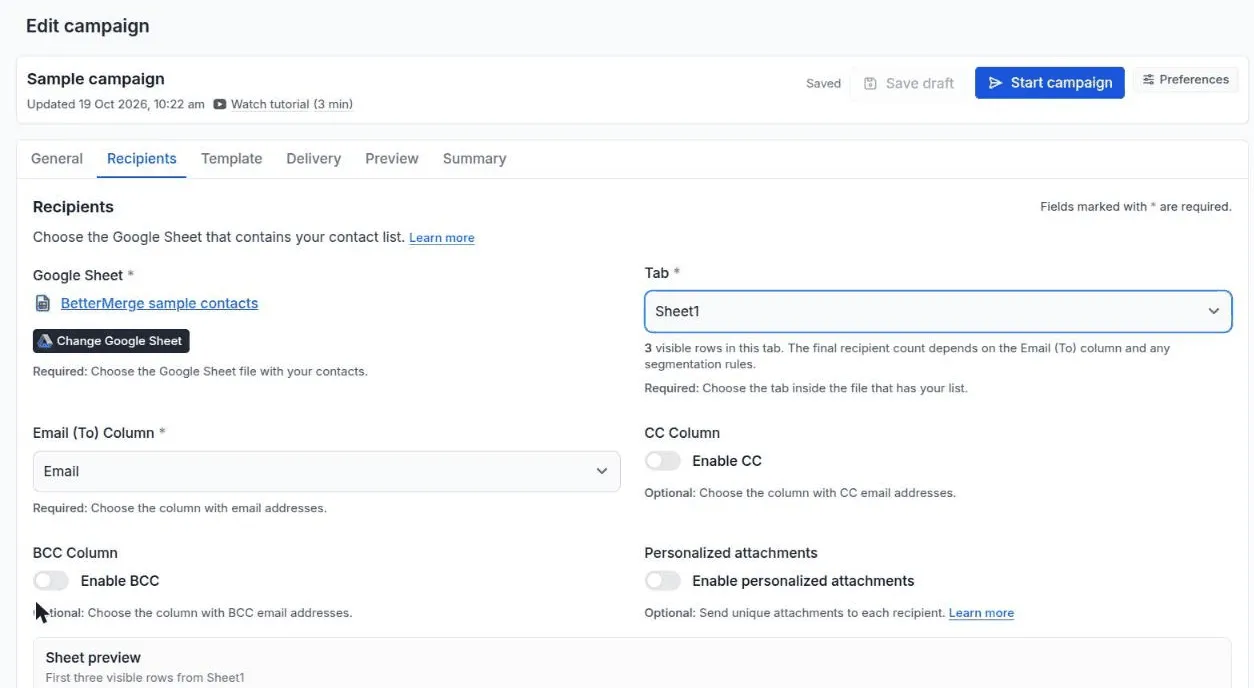
Section titled “Step 3: Choose Your Recipients (Recipients Tab)”- Google Sheet (required): click the picker button and choose your Sheet. To use a different one later, click Change Google Sheet.
- Tab (required): choose the sheet tab with your list. BetterMerge shows how many visible rows it has and how many hidden or filtered rows will be skipped.
- Email (To) Column (required): choose the column that holds the email addresses. BetterMerge often selects it for you; check that it is right.
- Optional: turn on CC Column or BCC Column and pick the columns that hold those addresses.
- Optional: turn on Personalized attachments to send a different file to each recipient. See Personalized attachments.
Rows that are hidden or filtered out in the Sheet are skipped, and so are contacts who have unsubscribed or whose address has bounced (see Sendable and Subscribed Contacts). Below the fields, Segmentation lets you send only to rows that match rules, for example one Company. Segmentation is available on the Lite plan and above. See Skip rows and Segmentation rules.

Step 4: Pick or Write the Email (Template Tab)
Section titled “Step 4: Pick or Write the Email (Template Tab)”The Template tab holds the email itself.
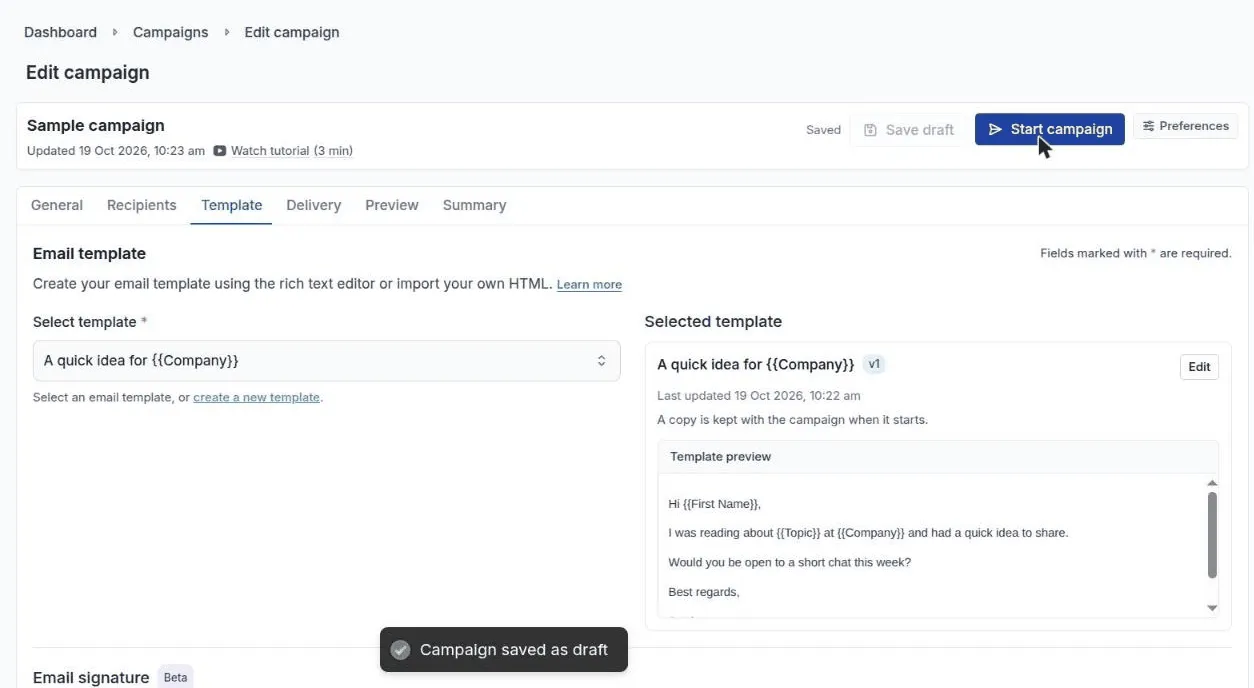
- Select template: open the list to see your templates. Search by name or subject, and use Load more to see further down the list.
- Write your email or create a new template: opens the template editor for a new template. When you are done, click Back to campaign. The new template is selected for you.
- Edit: opens the selected template. Your campaign is saved first, and Back to campaign returns you here.
Once a template is selected, the tab shows its name, version, and a Template preview. The preview does not fill in merge tags yet. Use the Preview tab for that.
A merge tag is a column name in double curly braces, such as {{First Name}}. Names must match the column headers exactly, including capital letters and spaces. If a tag has no matching column, a red notice lists the tags and where they are used, and the campaign cannot start until you fix it. Empty cells are fine. Only the column has to exist.
BetterMerge keeps a copy of the template with the campaign when it starts. Editing the template later does not change a campaign that is already running or finished.
Below the template, Email signature lets you use your account default, skip the signature for this campaign, or choose a specific one. See Email signatures. To write or review the email with AI, see AI assistant.
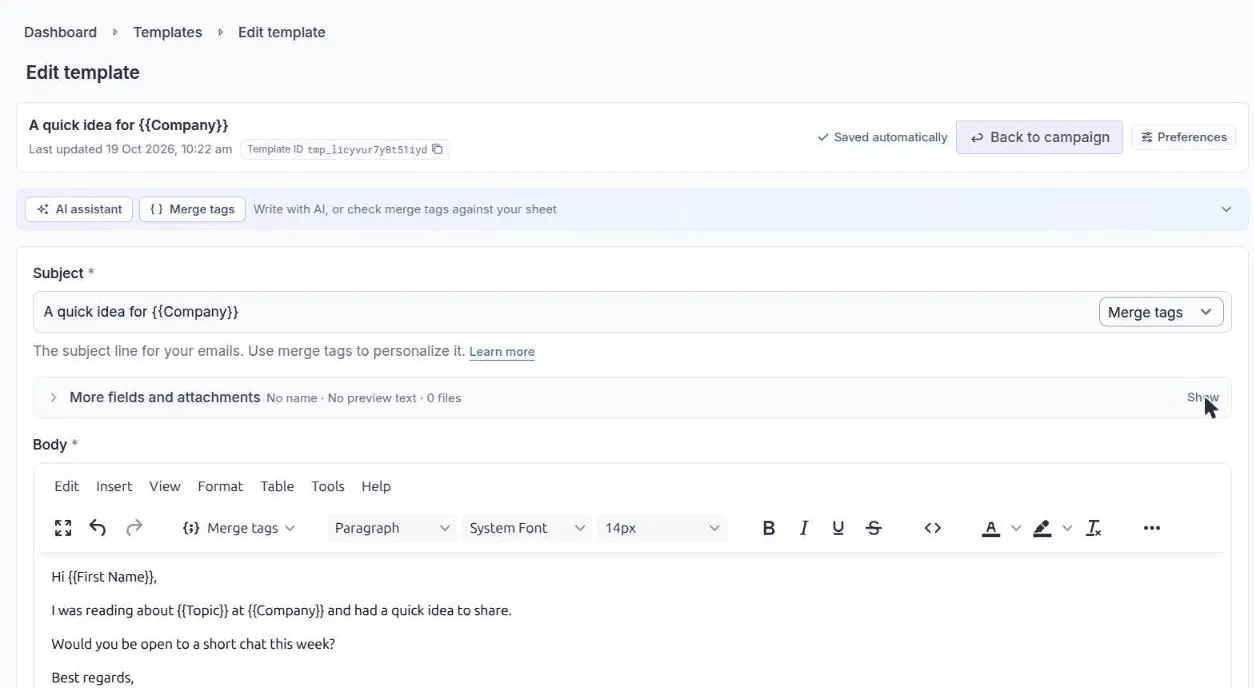
For formatting, images, and links, see Create an email template.
Step 5: Set Tracking and Delivery (Delivery Tab)
Section titled “Step 5: Set Tracking and Delivery (Delivery Tab)”Everything on this tab is optional.
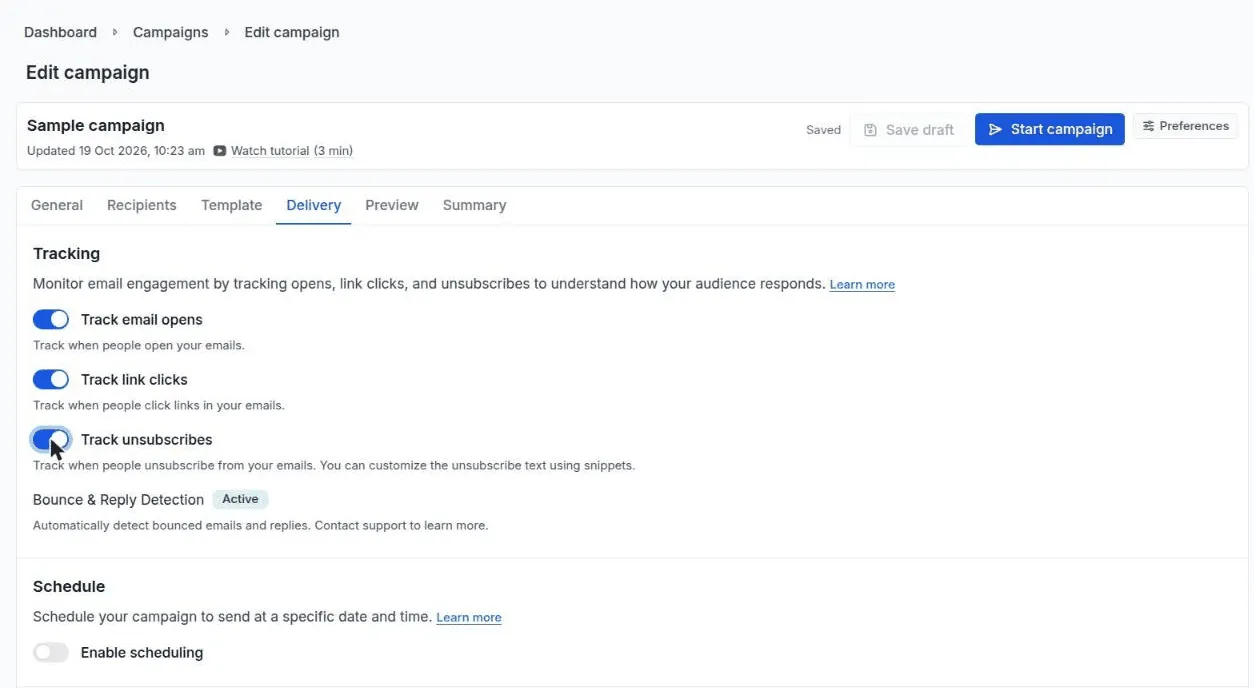
Tracking
- Track email opens and Track link clicks are included on every plan.
- Track unsubscribes adds an unsubscribe link to the email and records opt-outs.
- Bounce & Reply Detection shows Active or Not active. It is an optional Pro feature set up with the help of our support team. See Replies and bounces.
Read more in Tracking.
Schedule
Turn on Enable scheduling and choose Select date & time to send later. Times use your time zone, which is shown below the field. Scheduling is available on the Lite plan and above. See Schedule a campaign.
Delivery automation
Set a daily limit for this campaign, a delay between emails, sending days, and sending hours. These controls are available on the Plus plan and above. See Delivery automation.
Email verification
Checks addresses before sending to reduce bounces. Available on the Pro plan. See Email verification.
Step 6: Preview and Send a Test (Preview Tab)
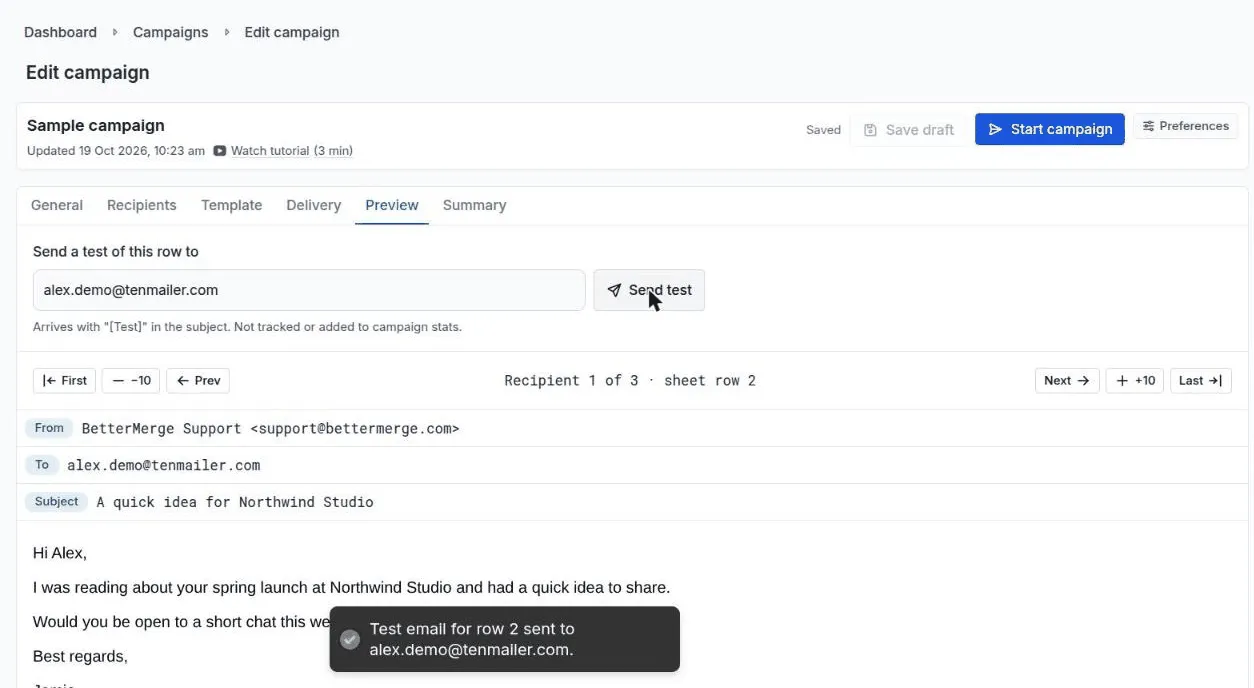
Section titled “Step 6: Preview and Send a Test (Preview Tab)”The Preview tab shows exactly what each recipient will get.
- Use First, Prev, Next, Last, and the −10 and +10 buttons to move through recipients. The counter reads, for example,
Recipient 2 of 3 · sheet row 3. - The preview shows From, To, Cc, Bcc, Subject, any attachments, and the body with that row’s data and your signature filled in.
- A yellow notice means the row will be skipped (hidden, filtered, or outside your segmentation rules). A red notice lists merge tags with no matching column.
Under Send a test of this row to, enter up to three email addresses separated by commas and click Send test. The address field starts with your own account email.
- The test shows the row you are previewing.
- The subject starts with
[Test]. - Tests are not tracked and are not counted in campaign statistics.
- The test uses the saved campaign, so wait for Saved before you send. If there are unsaved edits, the form tells you to save first.
Step 7: Review the Launch Checks (Summary Tab)
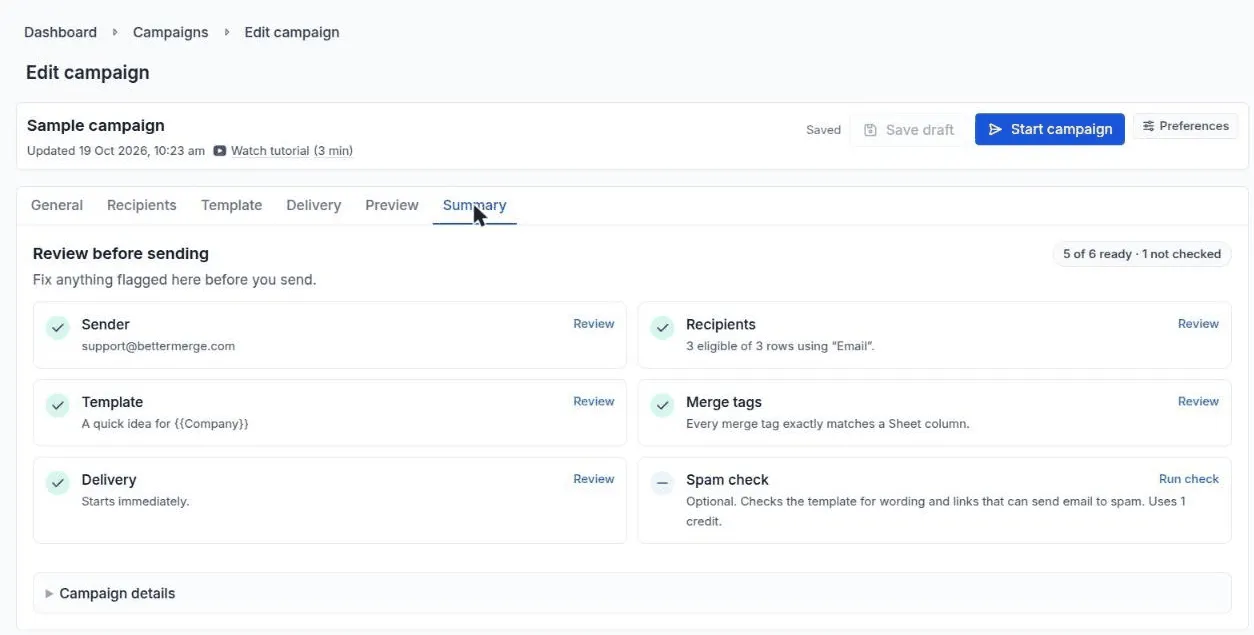
Section titled “Step 7: Review the Launch Checks (Summary Tab)”The Summary tab, titled Review before sending, lists what BetterMerge checked and what the campaign will do:
| Check | What it tells you |
|---|---|
| Sender | Which address the email will come from. |
| Recipients | How many eligible recipients there are, or that none were found. |
| Template | That a template with a subject line is selected. |
| Merge tags | Whether every tag has a matching column. |
| Delivery | When and how fast the email goes out, including a day-by-day estimate. |
Each check shows Ready or a Review link that jumps to the tab where you can fix it. The Summary can also run an optional spam check on your template, which uses AI credits. See AI assistant.
Step 8: Start the Campaign
Section titled “Step 8: Start the Campaign”Click Start campaign at the top right. If you turned on scheduling, the button reads Schedule instead.
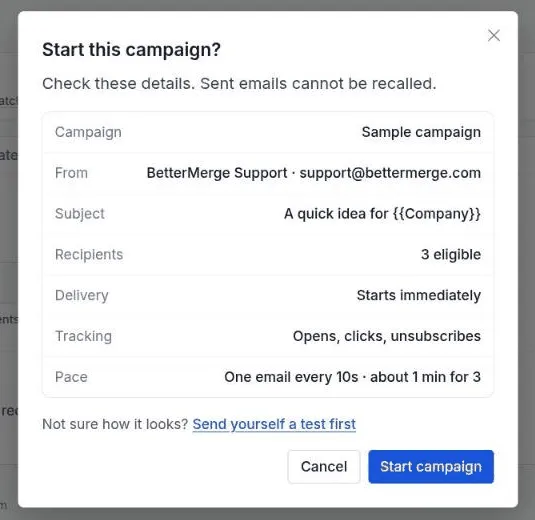
A confirmation window shows the Campaign, From, Subject, Recipients (as “eligible”), Delivery, Tracking, and Pace (one email every few seconds, with a time estimate). If your daily limit means sending will take more than one day, the window explains how it will be spread out. Click Send yourself a test first if you have not tested yet.
If anything is missing, the window is titled Finish setting up this campaign and lists each item with a link to the tab that fixes it:
- no Google Sheet, tab, or email column
- no template, or a template without a subject
- merge tags that do not match a column
- an invalid pace or sending-hours range
Fix those, then click Start campaign again. When the list is clear, click Start campaign (or Schedule campaign) in the window. Sent emails cannot be recalled.
How to Read the Campaign Report
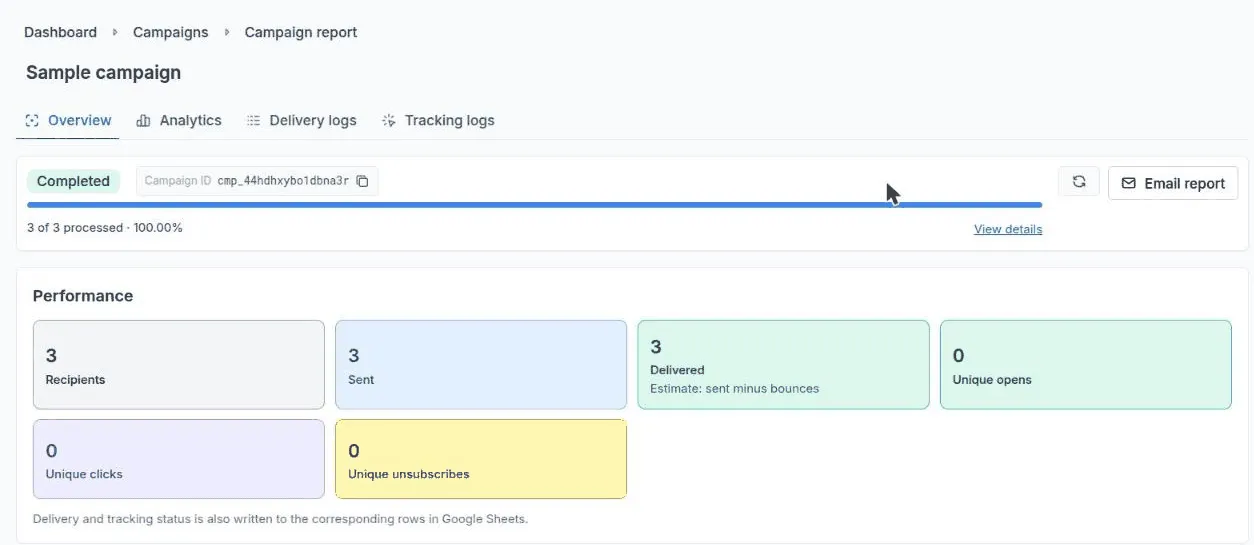
Section titled “How to Read the Campaign Report”After you start, BetterMerge opens the campaign report on its Overview tab. You can open it again any time from Campaigns in the left menu.
Status
Section titled “Status”The badge at the top tells you where the campaign is.
| Status | Meaning |
|---|---|
| Draft | Not started. Open it from Campaigns to keep editing. |
| Scheduled | Waiting for its start time. Click Unschedule and edit to return it to a draft. |
| In progress | Sending now. The progress bar shows sent, skipped, and error counts against recipients. |
| Waiting · continues … | A daily limit was reached. Sending continues at the time shown. |
| Paused | You paused it, or it reached the Free plan’s daily limit. Click Resume to continue. |
| Paused due to error | Sending hit a problem and stopped. Click Resume to try again. |
| Completed | Every eligible recipient has been processed. |
| Stopped | You stopped it. It cannot be resumed. |
| Failed | It could not run. Nothing more will send. |
The progress bar and View details link sit under the badge. Use Pause, Resume, and Stop as needed. See Pause, Resume, and Stop. Edit delivery changes the pacing of a campaign that is scheduled, sending, or paused.
Performance
Section titled “Performance”- Recipients: the people the campaign will email.
- Sent: emails sent through your Gmail account so far.
- Delivered: an estimate, sent minus known bounces.
- Unique opens, Unique clicks, Unique unsubscribes: one count per person. A label reads “(not enabled)” if you left that tracking off.
Errors and Bounced appear only when there is something to count.
Open Rates and diagnostics below the counts to see each number as a rate: delivery, open, click-to-open, click-through, bounce, error, unsubscribe, skipped, and reply. Each rate says what it is a share of, such as recipients or estimated deliveries.
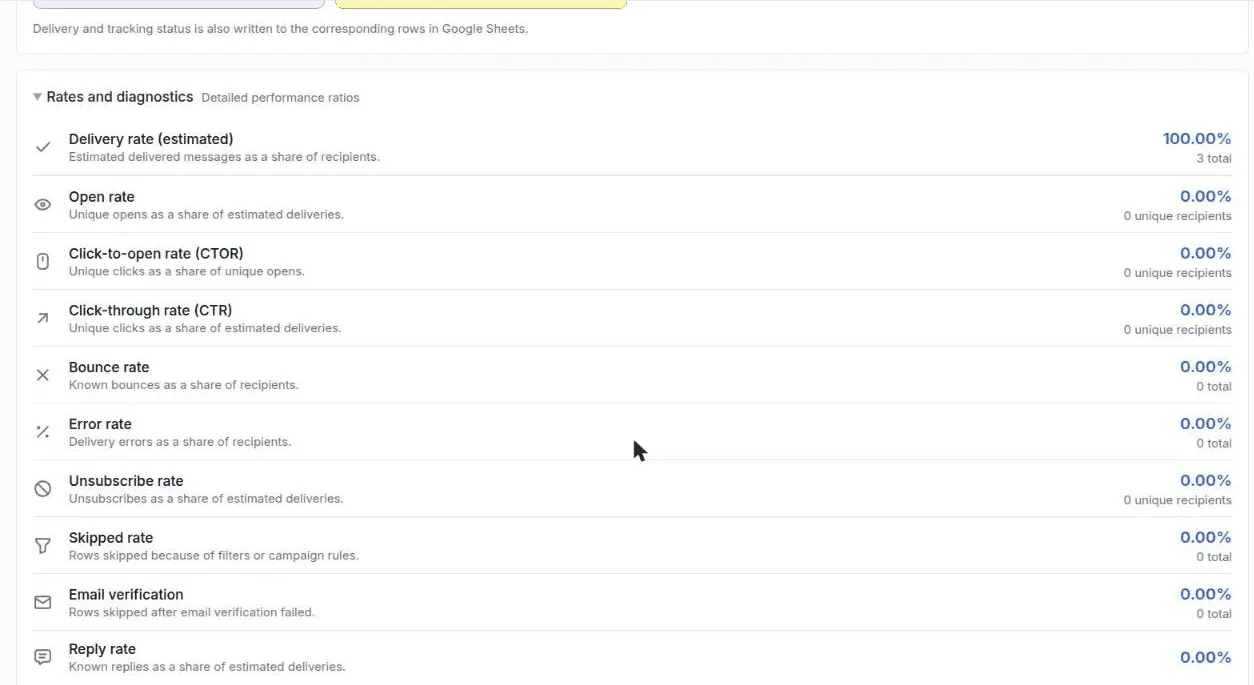 Opens are an estimate, because some mail apps load images automatically. See Open tracking.
More Detail
Section titled “More Detail”The tabs at the top of the report lead to more detail.
- Analytics: an Engagement funnel from sent to opened and clicked. The Activity over time chart (daily sends, opens, clicks, and unsubscribes) is available on paid plans.
- Delivery logs: one line per email with its outcome. See Delivery logs.
- Tracking logs: opens, clicks, and unsubscribes. See Tracking logs.
- Email report (on completed campaigns): sends a copy of the report to your inbox. BetterMerge also emails one when a campaign finishes.
- Campaign setup: expands the sender, recipients, template, and delivery settings the campaign used.
In Your Google Sheet
Section titled “In Your Google Sheet”The Sheet gains two columns named STATUS (Campaign name) and LOGS (Campaign name). They show each row’s status (SENT, OPENED, CLICKED, SKIPPED, and more) and a time-stamped log. See Status and logs columns.
Sendable and Subscribed Contacts
Section titled “Sendable and Subscribed Contacts”BetterMerge keeps a record of everyone you email on the Contacts page. Each contact shows one status:
| Status | Meaning | Receives your campaigns? |
|---|---|---|
| Sendable | No opt-in or opt-out is recorded. This is the normal state for people added from a Google Sheet. | Yes |
| Subscribed | You recorded that the person agreed to receive your emails. | Yes |
| Unsubscribed | The person opted out, through your unsubscribe link or because you set it. | No, skipped |
| Bounced | An email to the address hard-bounced, or you set it. | No, skipped |
Sendable and Subscribed are treated the same when you send. The difference is only whether you have a record of consent. Whether an address bounced is tracked separately from consent, so a Subscribed contact can still be skipped if their address bounced. These protections apply across all of your Sheets. Read more in Manage your contacts.
If Something Goes Wrong
Section titled “If Something Goes Wrong”A draft did not save. Your edits stay in the editor while it is open. If you try to leave while Not saved or Unsaved is showing, BetterMerge asks Leave without saving? so you can stay and fix it. If you leave another way, for example with the browser’s back button, the edits that could not be saved are kept on that device. The next time you open the campaign, a banner reads Unsaved edits found. Click Restore edits to bring them back, or Discard to drop them. They are not shared across devices.
A campaign shows Paused or Paused due to error. Open the report and click Resume. If it pauses again, open the Delivery logs to see what went wrong.
A campaign was Stopped or Failed. These cannot be restarted, and what was already sent cannot be recalled. To send to the remaining people, open Campaigns, click the Options menu on the campaign, and choose Duplicate. The copy is a new draft with the same Sheet, template, and settings. Before you start the copy, hide or filter the rows already marked SENT in your Sheet so nobody receives the email twice. See Skip rows.
A scheduled campaign needs a change. Open its report and click Unschedule and edit. It becomes a draft again; edit it and re-schedule.
Next Steps
Section titled “Next Steps”New to BetterMerge?Start free — 50 emails/day, no credit card. Questions? Contact support.
BetterMerge is an independent product not affiliated with, endorsed by, or connected to Google LLC. Gmail, Google Sheets, Google Workspace, and Google Workspace Marketplace are trademarks of Google LLC.